Optimus can catch a ball, pick up an egg, and sort parts. So how far are we from a humanoid robot taking over the last stronghold of human soldering in electronics manufacturing? Not far in the headlines, but a long way in reality. Neither humanoid robots nor the specialized machines that already run factory floors are close to replacing the skilled technicians who hand-solder the industry's most complex, highest-reliability boards. Here is why.
Can Tesla's Optimus Actually Solder?
Tesla's Optimus has captured the public imagination as the future of factory labor. As of mid-2026, though, the units deployed in Tesla's own facilities are limited to basic material handling: moving parts bins, carrying components, and sorting small items, not precision assembly or soldering. Tesla itself has described Optimus as still in an R&D phase, used to observe and learn basic functions rather than run production-grade tasks.
The hand hardware has genuinely advanced, with recent generations reportedly adding many more actuators and tendon-driven fingers aimed at what Tesla calls superhuman precision, and demo footage shows it folding laundry and catching thrown objects. But there is a real gap between general dexterity and the specific, adaptive control that soldering demands.
Why Purpose-Built Machines Already Handle Most Soldering
Long before Optimus, the electronics industry solved most of its automation with purpose-built machines. Pick-and-place robots assemble the vast majority of circuit boards at extraordinary speed, with the fastest machines placing well over a hundred thousand parts per hour on surface-mount boards. For soldering specifically, robotic soldering arms replicate the mechanics of hand soldering with fixed-angle irons, automated solder feed, and programmable motion, encoding a technician's feed rate, heating time, and dwell time as repeatable instructions.
More advanced equipment closes even more of the gap. Selective soldering targets individual through-hole joints with programmable control over solder volume and temperature. Laser soldering uses a focused, non-contact beam for fine-pitch, delicate work. Some robotic cells now add real-time vision that inspects each joint as it forms and adjusts for part position or board flex. A specialized soldering machine does not need to walk, balance, or generalize; it just executes one job with precision, which is exactly what it is built to do.
Where even the best machines stop
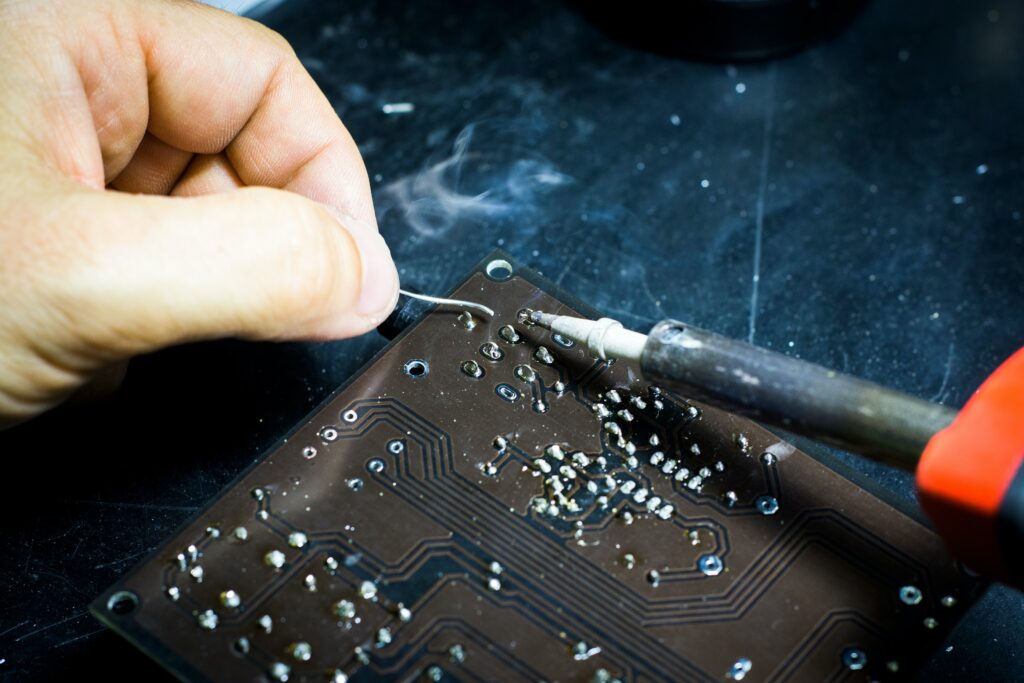
Despite decades of maturity, none of this equipment is deployed for the industry's hardest rework and hand-solder-tier work, and there is a specific reason. Hand soldering is not purely a motor-skill task, it is a diagnostic one. A skilled technician reads a joint in real time, watching how solder wets the pad, how heat flows through the connection, and how the component responds, then adjusts angle, dwell, and heat on the fly. Even highly automated plants keep technicians on staff because automated equipment can misjudge tight pad spacing and bridge pins that must stay separate. Vision systems confirm what a joint looks like or where a part sits, but they do not sense heat flow or judge solder wetting mid-process the way a person does. The boards still done by hand are exactly the ones where conditions vary joint to joint, making pre-programmed parameters unreliable.
Why humanoid robots can't close the gap either
This is the deeper issue that applies to Optimus and any future humanoid: the unsolved challenge is not raw dexterity or joint count, it is what robotics engineers call compliant actuation and force awareness, the ability to sense contact force and thermal feedback in real time and adjust like a person, rather than run a pre-taught rigid path. Even the newest hand hardware highlights this limit: a robot might handle an egg without cracking it and still not solve the core problem of safe, adaptive, real-world manipulation.
A multi-year research problem, not a roadmap item
For a humanoid to reach the bar set by the most complex hand-soldered boards, it would need general-purpose adaptive manipulation: sensing, judgment, and real-time correction that mimics human tactile and visual feedback. That is a fundamental robotics research problem, not an incremental hardware upgrade any one company can engineer around in a product cycle. Progress is better tracked by sub-capabilities than by hardware generations:
- Tactile sensing is still minimal beyond the fingertips, limiting the feel needed for delicate work.
- Robots still struggle to manipulate objects while moving, something people do unconsciously during assembly.
- Hand-dexterity programs are still chasing natural rather than mechanical motion after years of iteration.
- Actuator durability over full industrial shifts remains a mechanical bottleneck.
- Current learning systems need very large trial counts just to generalize simple skills to new environments.
Across recent reporting, credible voices are extending timelines, not shortening them, with decades the recurring word.
What this means for high-reliability manufacturers
The result is a durable division of labor. Mass-production boards go to pick-and-place and reflow. Moderately complex or awkward joints go to programmable soldering robots. The most demanding, highest-reliability, hand-solder-tier boards stay with certified human technicians. For industries built around IPC standards like J-STD-001 and IPC-A-610, where a single misjudged joint can mean mission failure, that division of labor is likely to persist well beyond the next generation of humanoid robots.
So will robots remove humans from the soldering loop? Not any time soon. The smarter move is to invest in the skill that remains decisive: certified, trained hand-soldering operators.
Frequently asked questions
Will robots replace hand soldering?
Not for the foreseeable future. Automation handles high-volume and repeatable joints, but the most complex, high-reliability boards still require certified human technicians who read and adjust each joint in real time.
Can Tesla's Optimus solder circuit boards?
Not in production. As of mid-2026 Optimus is used for basic material handling, not precision assembly or soldering, and remains in an R&D phase.
Why is hand soldering still done by humans?
Because it is a diagnostic, adaptive task. Technicians sense heat flow and solder wetting and adjust on the fly, something current machines and humanoid robots cannot yet do reliably.
What is the hardest part of automating soldering?
Real-time force and thermal awareness: feeling a joint form and correcting instantly, rather than following a fixed, pre-taught path.
The people who hand-solder high-reliability boards are trained and certified, not hired off the street. Explore EPTAC's Hand Soldering Operator Certification at eptac.com/class/hand-soldering-certification.